
Chain of Trust
INFO
This page covers the foundation of the Nox chain of trust: the TEE layer and boot-time attestation. It explains how each Nox off-chain service is verified before it is granted access to any secret.
Why a Chain of Trust?
Nox performs confidential computations over encrypted user data in off-chain services. For such a system to be trustworthy, you must be convinced of a non-trivial property:
- The code processing your data is exactly the code iExec claims to deploy
- It executes on genuine confidential-computing hardware
- Neither the cloud provider nor the protocol operator can observe or tamper with the data while it is being processed
Establishing this property requires a chain of trust: a sequence of cryptographically verifiable links connecting a hardware root of trust to the running workload. Each link is independently checkable, so an external party can conclude, end to end, that a given Nox component is genuinely running the expected code on genuine confidential hardware.
Several Nox off-chain services handle sensitive material in clear within their address space: plaintext operands in the Runner, input plaintext and ciphertext in the Handle Gateway, and the protocol private key in the KMS. Protecting their confidentiality and integrity is the central security concern the chain of trust addresses, which is why each of them is deployed as an Intel TDX confidential workload.
Boot-Time Verification
The foundational link of the chain is boot-time verification:
A Confidential VM (CVM) cannot obtain the secrets it needs to operate unless it has booted a known operating-system image and a known application stack on attested TDX hardware.
The rest of this page explains how this guarantee is built, layer by layer: the hardware (Intel TDX), the orchestration (dstack), the deployment architecture, and the gating mechanism itself.
Verify it yourself
The live companion to this page is the Nox Attestation portal: it lists every Nox component instance in the fleet (Runner, KMS, Handle Gateway, Ingestor), the TDX node it runs on, and its live TDX quote. You can also re-verify each attestation on demand.
The Hardware Root of Trust: Intel TDX
Intel Trust Domain Extensions (TDX) is a capability of recent Intel Xeon processors that lets a virtual machine run as a Trust Domain (TD), isolated from the host operating system, the hypervisor, and the cloud operator. Two properties make TDX a suitable root of trust for Nox:
Confidentiality and integrity of runtime state. The CPU transparently encrypts the memory of each TD, so neither the host nor a privileged operator can read or undetectably modify the guest's memory. Each Nox service runs inside a hardware-isolated CVM whose runtime state is opaque to the hosting provider.
Measured boot and remote attestation. As a TD launches, the BIOS and the TDX module measure its initial state into a set of registers (the static measurement MRTD and the runtime-extendable registers RTMR[0..3]), recorded in a signed TD-Report. From this report, the platform produces a quote, signed through Intel's Data Center Attestation Primitives (DCAP) and chaining up to the Intel SGX Root CA. A remote verifier validates this quote to obtain a hardware-backed statement of which code the TD runs, and evaluates the platform's Trusted Computing Base (TCB) status against Intel collateral, accepting only an up-to-date TCB.
Hardware Baseline
Nox runs only on bare-metal servers satisfying Intel's TDX enabling guide:
| Requirement | Baseline |
|---|---|
| CPU | 5th-generation Intel Xeon Scalable, or Intel Xeon 6 |
| Memory | Fully populated IMC channels (≥ 8 DIMMs per socket) |
| BIOS | TDX, SGX and TME-MT enabled |
| Kernel | Canonical TDX-patched kernel |
| Quote generation | Intel Quote Generation Service (QGS) on the quote-generation vsock port |
| Certificate cache | Local Intel PCCS caching the PCK certificate chain to embed it in the quote |
The Orchestration Layer: dstack
dstack is the open-source orchestration layer, developed by Phala Network, that operates CVMs on top of TDX. It removes the need to manage Trust Domains by hand and provides the gating mechanism on which boot-time verification rests. Its main components are:
- A Virtual Machine Monitor (VMM) and supervisor that boot and supervise CVMs from a measured, reproducible dstack OS image
- A dstack-KMS CVM that derives application keys inside the enclave and decides which workloads may boot by checking their measurements against a whitelist
- A dstack-gateway CVM that terminates public TLS (with automatic ACME certificates) and reverse-proxies traffic to each registered CVM over an encrypted WireGuard overlay, load-balancing natively between CVMs that share the same application identifier (
app_id)
dstack also offers an optional on-chain authorization contract (DstackKms) able to whitelist OS-image and per-application compose hashes. Nox currently keeps this whitelist off-chain; anchoring the set of authorized measurements on-chain is planned as a later link of the chain of trust.
Deployment Architecture
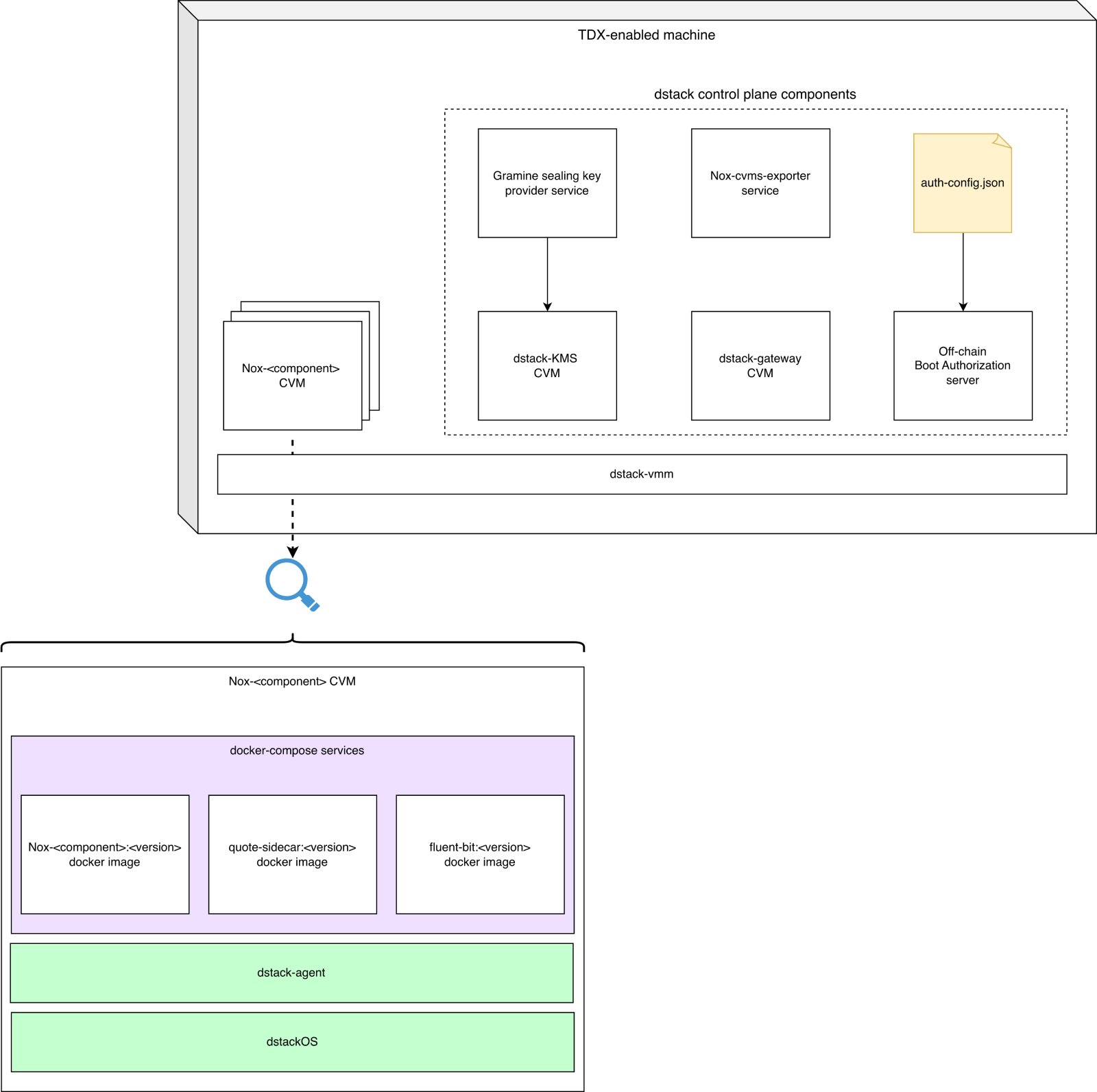
On the TDX Host
| Component | Role |
|---|---|
dstack-vmm | Boots and supervises every CVM and exposes the deployment interface |
dstack-KMS CVM | Authorizes or prohibits CVM boots according to the Boot Authorization server decision |
dstack-gateway CVM | Terminates public TLS (ACME certificates) and reverse-proxies external traffic to each registered CVM over a WireGuard overlay |
| Boot Authorization server | Checks whether a CVM is authorized to boot according to its configuration file auth-config.json |
auth-config.json | Maps each authorized CVM identifier (app_id) to its expected compose file hash (compose_hash), and lists the authorized guest OS by hash |
| Gramine Sealing Key Provider | SGX service that provides a local sealing key to the dstack-KMS during its first boot |
| Nox CVMs exporter | Host-side service that exposes, for every CVM on the host, the URL of its quote-service endpoint, so a TDX quote can be generated in real time for any CVM |
| Nox CVMs | Business confidential VMs running the Nox off-chain services: nox-handle-gateway, nox-runner, nox-kms, nox-ingestor |
Inside a Nox CVM
| Component | Role |
|---|---|
| Nox service | The Nox business service proper, a Rust binary (e.g. nox-kms) running part of the protocol logic |
quote-sidecar | Sidecar mounting the dstack guest socket to expose the CVM's live TDX quote, so an external verifier can fetch and attest it in real time |
fluent-bit | Log-forwarding sidecar shipping container logs to a central observability stack |
dstack-agent | dstack guest agent; mediates interaction with the dstack control plane, requests keys from the dstack-KMS over the TDX-attested channel and serves the CVM's attestation and app metadata |
dstackOS | The reproducible dstack guest operating system the CVM boots; its measurement (os_image_hash) is taken at boot and checked against the whitelist before any key is released |
How a CVM Is Gated at Boot
Every CVM (gateway, KMS, or Nox business service) follows the same attested, authorized key-provisioning path before it can start serving:
Boot and measurement. The VMM starts the CVM under TDX. The CVM boots the dstack OS image and measures its application info (the
compose_hash, the derivedapp_idand theinstance_id), extending these values intoRTMR[3].Mutual attestation. The CVM builds an RA-TLS certificate embedding its live TDX quote and requests its application keys from the dstack-KMS over mutually-authenticated TLS. Each side verifies the other's attestation.
Authorization. The dstack-KMS extracts the boot info from the attestation and calls the Boot Authorization server, which authorizes the boot only if all five checks pass:
- the platform TCB status is up to date
- the OS-image hash matches the whitelist
- the
app_idmatchesauth-config.json - the
compose_hashmatchesauth-config.json - the device id matches
auth-config.json
On refusal, the CVM reboots or shuts down. It never receives any key.
Key release and encrypted disk. On success, the dstack-KMS derives the per-app keys from its root keys and returns them. The CVM mounts its encrypted disk with the
disk_crypt_keyand decrypts its sealed environment variables.Service start. Only then does docker-compose start the application containers. Nox business CVMs additionally register with the dstack-gateway to join the encrypted WireGuard overlay through which they are reached.
The dstack-KMS itself is bootstrapped differently: on its very first boot it obtains a hardware-bound sealing key from a local SGX key provider after proving its measured identity, and generates the protocol root keys. Any subsequent KMS instance must pass the same Boot Authorization checks before receiving the root keys from an existing KMS.
The net effect: no known measurement, no keys; no keys, no disk, no secrets, no service.
Detailed Boot Sequences
The full, step-by-step sequence diagrams are public:
Sealed Environment Variables
Secret environment variables (API keys, credentials…) are encrypted by the operator before deployment and decrypted only inside the attested CVM, so that neither the VMM nor the dstack-KMS ever sees their plaintext:
- The operator fetches a per-app X25519 public encryption key from the dstack-KMS, verified through a signature from a whitelisted signer.
- The variables are encrypted client-side with an ephemeral X25519 key exchange + AES-256-GCM, and the resulting blob is handed to the VMM, which stores it without ever being able to decrypt it.
- During key provisioning, the attested CVM receives the corresponding private key (
env_crypt_key) over the attested channel, recomputes the shared secret, decrypts the variables, and filters them against theallowed_envslist from its compose file.
This construction provides confidentiality (only the attested CVM can decrypt), integrity (AES-GCM detects tampering), forward secrecy (each deployment uses a fresh ephemeral key), and blindness of both the VMM and the KMS. The key is derived per app_id, so instances of the same app share it while different apps cannot read one another's variables.
See the full environment-variable encryption sequence.
Proof-of-Cloud: Hardware Provenance
Measured boot and remote attestation establish what code a CVM runs and that it runs on genuine Intel TDX silicon. They do not, by themselves, establish where that silicon is: the physical and operational provenance of the host.
Proof-of-Cloud is the complementary seal that addresses this gap: it binds an attested TDX platform to a known, reputable hosting environment. It is coordinated by the Proof of Cloud Alliance, a vendor-neutral group of which iExec is a member, that maintains a signed, append-only registry binding TEE hardware identities (the Intel DCAP PPID extracted from the attestation quote) to independently verified physical facilities. Member organizations cross-verify each location during a dedicated whitelisting ceremony, so a verifier can establish not only that a workload runs on genuine TDX silicon, but also that this silicon sits in a facility multiple independent parties have vouched for.
In the current Nox fleet, this property is tracked per node. The testnet fleet runs two TDX nodes: node1, hosted at OVH, and node2, hosted at phoenixNAP. Of these two, node1 carries a Proof-of-Cloud seal and node2 does not. The distinction is meaningful for an external verifier: where present, Proof-of-Cloud raises the cost of relocation or substitution attacks by tying the attested platform to a provider's verified infrastructure, rather than relying on the quote alone to vouch for an otherwise anonymous host. Within the chain of trust, it should be read as a provenance complement to TDX attestation, not a replacement: TDX attests the integrity and identity of the execution environment, while Proof-of-Cloud attests the integrity of its hosting context.
Beyond Boot-Time Attestation
Boot-time verification is the foundation of the chain of trust, but not its full extent. The higher links build on it:
- Runtime attestation: surfacing live attestation evidence to end users (already explorable today on the Attestation portal)
- Source-code binding: proving that the running images are built from the public source code
- On-chain governance: anchoring the set of authorized measurements on-chain
Learn More
- Nox Attestation portal: live, re-verifiable attestation evidence for every component instance in the Nox fleet
- Chain of Trust for Nox: the original iExec publication of this article
- How iExec Uses dstack For OnChain Finance: Phala's perspective on the dstack integration and runtime quote generation